Dilo
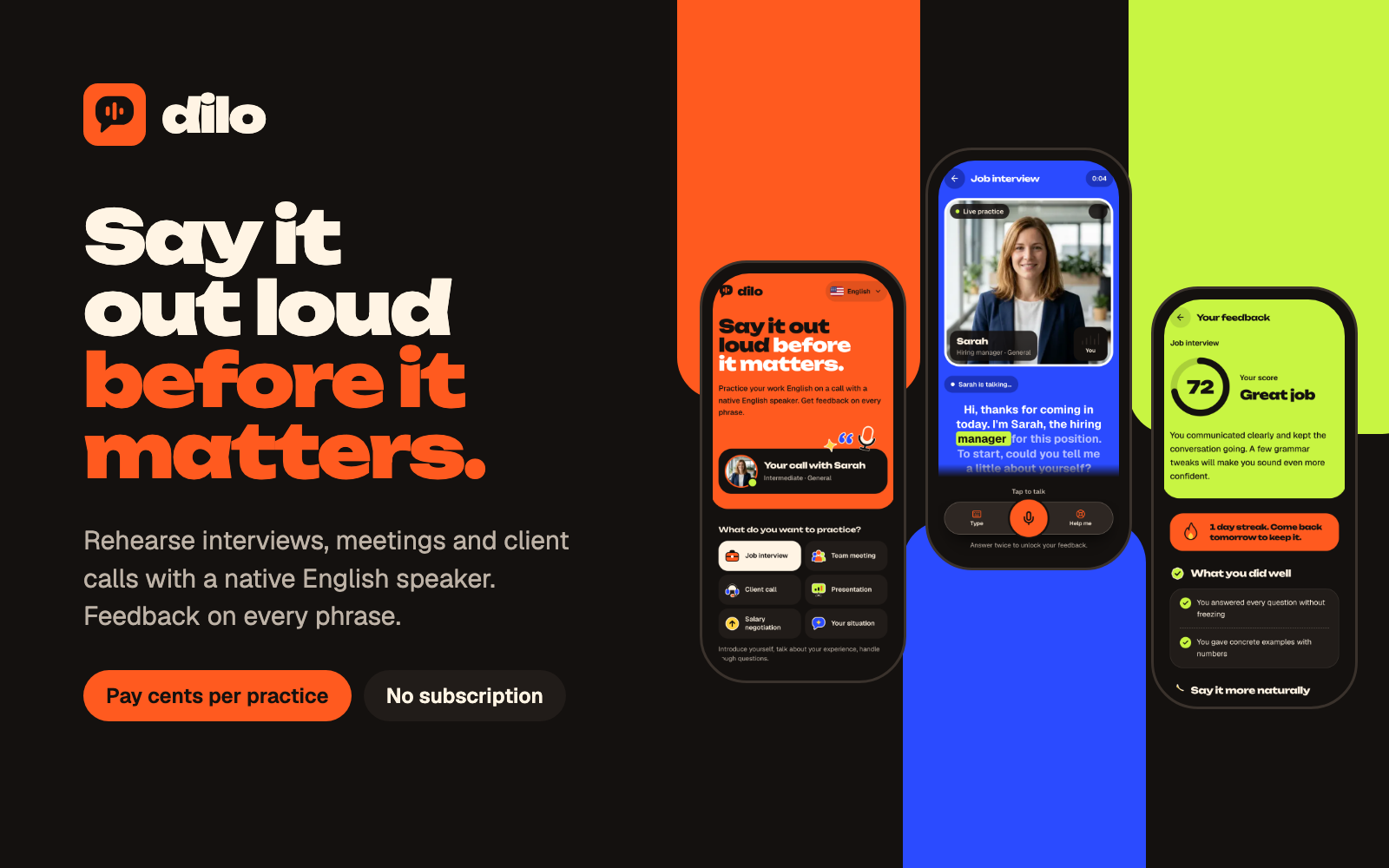
Practice your work English out loud with a US coworker. Pay cents per practice.
AI: publik API or your key
publik verified: the founder reviewed this exact version for malware and approved it
Where Dilo’s AI runs, and what it costs
Prices are for one typical use: one request of about 1,500 words sent and 375 words back. A higher quality score is better.
On your computer
Not checked yet: publik has not read whether Dilo can run its AI on your computer.
publik API
- Price
- $0.0010 per use, $1.00 per 1,000 usespublik-fast, the level Dilo uses most
- Quality
- GLM-5.3 Flash: 42
- Setup
- Built in. No key to paste; link your publik account and start the 7-day free trial to try it.
Your own key
- Price
- $0.0006 per use, $0.55 per 1,000 usesGLM-5.3 Flash at OpenRouter’s list price, before its fee for buying usage
- Quality
- GLM-5.3 Flash: 42
- Setup
- Open a provider account, add a card, paste the key into Dilo.
Quality and price, side by side
| Model | Quality | Per 1,000 uses |
|---|---|---|
| On your computer (Ollama, 4-bit download size) | ||
| Granite 4.2 3B2.2 GB | 9 | $0 |
| Phi-4 Mini2.5 GB | 6 | $0 |
| Llama 3.1 8B4.9 GB | 7 | $0 |
| gpt-oss 20B14 GB | 9 | $0 |
| Gemma 4 31B20 GB | 19* | $0 |
| Qwen3.5 35B-A3B24 GB | 19* | $0 |
| publik API | ||
| publik-fastGLM-5.3 Flash · Dilo | 42 | $1.00 |
| publik-balancedMiMo-V2.6-Pro | 46 | $10.00 |
| publik-smartGPT-6 Sol | 48 | $18.00 |
Quality: Artificial Analysis Intelligence Index v4.3.2, read 2026-09-22 (publik API models 2026-09-25); * = estimated by Artificial Analysis. Sizes: the Ollama library, read 2026-09-22.
What you pay for
- On your computer: nothing per use. You pay in disk space, memory and electricity, at lower quality.
- publik API: publik’s published price for each use, in dollars, from your publik balance. It is above the model’s cost; the difference runs publik and pays the app’s builder.
- Your own key: the provider’s price, billed to an account you keep with the provider.
README
Open in GitHub
Dilo: say it out loud before it matters
Practice your work English on a call with a native English speaker. Feedback on every phrase. Pay cents per practice, no subscription.
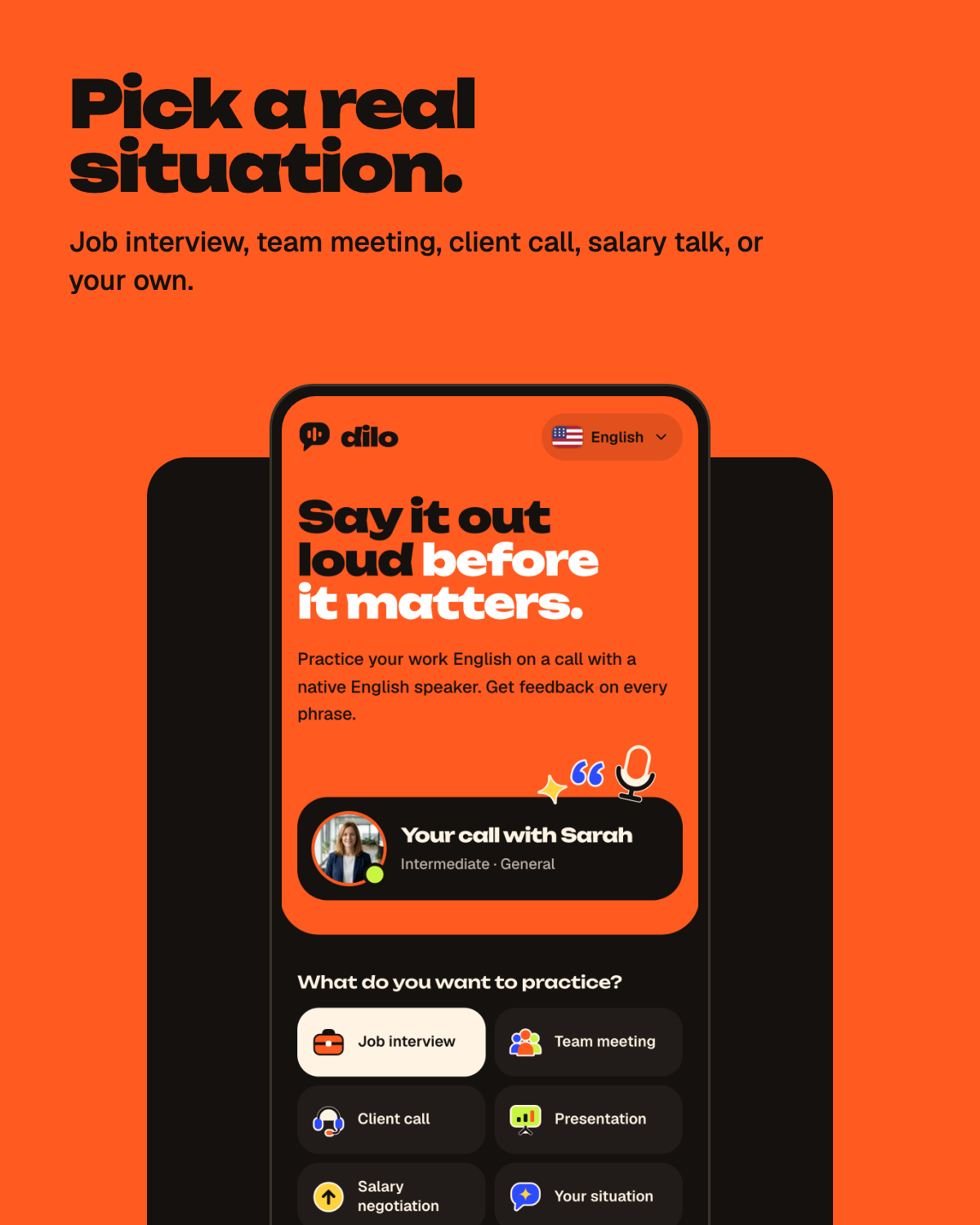
Dilo (Spanish for "say it") is a daily speaking practice for Spanish-speaking professionals who work or job-hunt in English. No subscription: you pay only the AI you use through publik, about $0.07 to $0.09 for a 10-minute practice. It focuses on work, where apps like Speak, Praktika and Cambly are general.
- Pick a scenario: job interview, team meeting, client call, presentation, salary negotiation, or your own situation (a meeting with your lawyer, a call with your landlord). Add details to make it real: paste the job post link or text, or describe the meeting.
- Pick your industry: general, sales, customer support, healthcare admin, construction or tech.
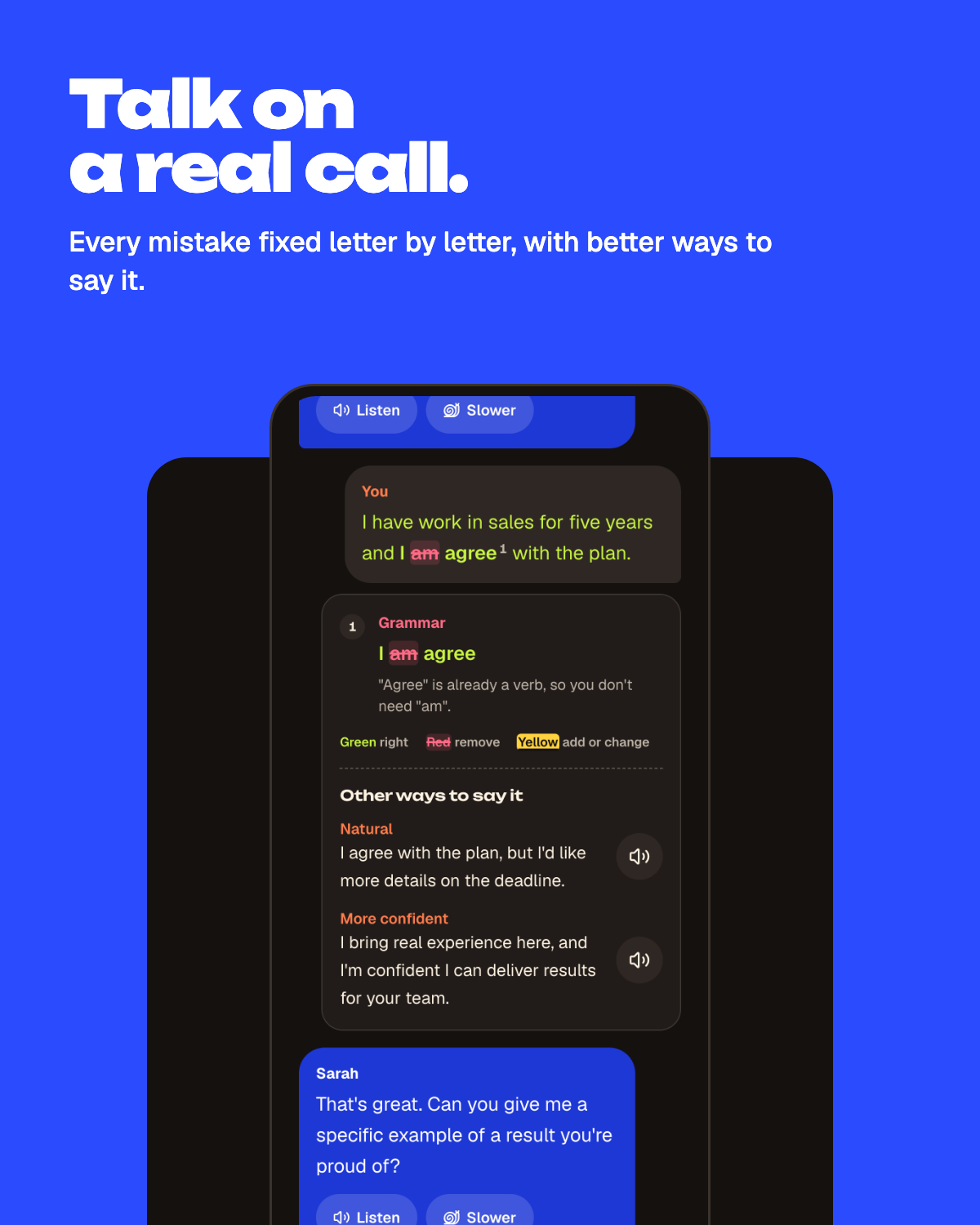
- Talk out loud on a video-call style screen with your chosen partner for 5 to 10 minutes (push to talk, or type if you have no mic). Their lines are captioned live, word by word. Stuck? "Help me" explains the question and suggests an answer. Your words appear about 2.5 seconds after you stop, exactly as you said them (mistakes included), and your partner's reply arrives together with its voice.
- Each answer is checked live: mistakes are corrected letter by letter inside your sentence (green right, red remove, yellow add), phrasing that doesn't sound natural is marked, and you get two other ways to say it, which you can hear.
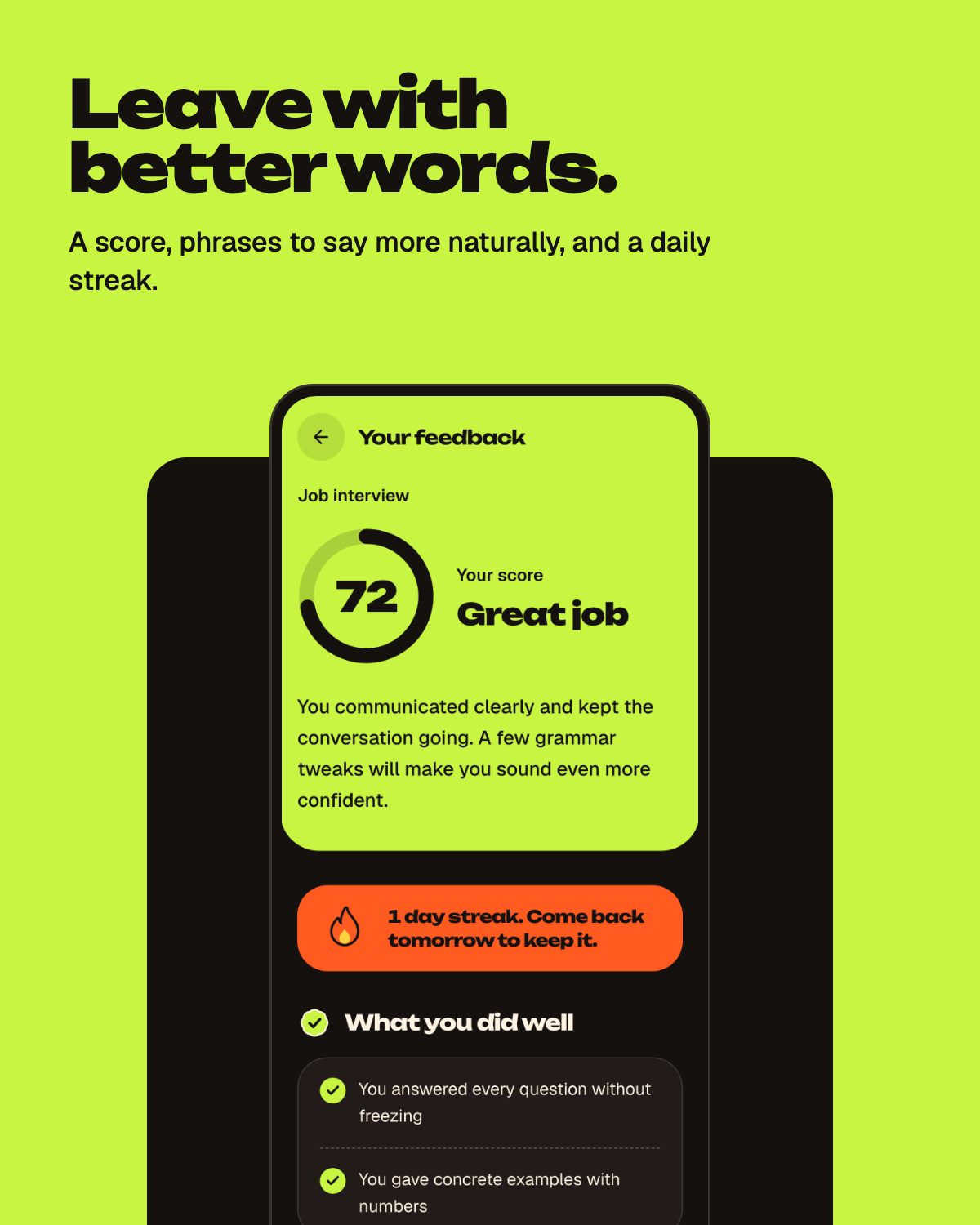
- Get feedback: what you did well, 3 phrases to say more naturally (with the better version), vocabulary to keep, and a score.
- "Say it" with a sound check: each better phrase shows how its words sound in General American English (respelling, strong syllable, the three sounds Spanish speakers should focus on). Say it out loud and see, letter by letter, what the AI heard, your pace and your own voice word by word. It comes back 1, 3 and 7 days later in "Today's review".
- Come back tomorrow: daily streak, your results (words spoken in English, phrases learned, score trend), session history and phrases to review.
The interface comes in English, Spanish, Portuguese, French, Italian and German (a language menu at the top; the browser's language is picked the first time). The conversation is always in English. Each learner picks a level: Beginner (simpler English, slower voice, tips and translations in your language), Intermediate (tips in English, translations in your language) or Advanced (natural speed, English only). They also pick a practice partner: four photo avatars (AI-generated portraits of fictional people, made with Blotato), each with its own voice.
Run it locally
Requirements: Node.js 22.13 or newer (it uses the built-in node:sqlite), npm.
npm install
npm run dev
Open http://localhost:3000. With no environment variables the app runs in demo mode: the AI is a deterministic mock, the counterpart speaks with your browser's English voice, and the whole flow (practice, feedback, streak, phrases, history) works offline. A small "Demo mode: simulated AI" chip says so on the home screen.
Other commands:
| Command | What it does |
|---|---|
npm test | Run the test suite (Vitest) |
npm run test:coverage | Tests plus coverage report (thresholds: 80% lines, branches, functions, statements) |
npm run typecheck | TypeScript check |
npm run lint | ESLint |
npm run build / npm start | Production build and server |
To use the real AI, copy .env.example to .env.local and follow PUBLIK-SETUP.md. Never commit real values.
Architecture
Browser (Next.js client components)            Server (Next.js route handlers, Node runtime)
-----------------------------------            ----------------------------------------------
MediaRecorder (push to talk)  --audio-->  POST /api/practice/:id/turn
                                             1. /audio/transcriptions (whisper-1)
                                             2. /chat/completions (publik-balanced) as the counterpart -> text shown at once
                                          POST /api/practice/:id/speech  { turnIndex }
                                             /audio/speech (tts-1-hd, the avatar's voice), cached in the page
Audio element or speechSynthesis  <--base64 mp3 or null (browser voice fallback)
                                          POST /api/practice/:id/help   ("Help me", publik-fast)
                                          POST /api/practice/:id/finish
                                             /chat/completions (publik-balanced, retry on publik-fast) -> JSON feedback
                                          POST /api/phrases/:id/drill    ("Say it": whisper-1 with word timings, clarity, pace, 1/3/7-day schedule)
                                          POST /api/pronounce            (sound check: CMU dictionary, no AI call)
                                          GET  /api/progress  (streak, last 7 days, history, phrases, due today)
                                          GET/POST /api/gate  (Sign in with publik)
                                          POST /api/telemetry (app_opened, active_session)
Layers (each file is small and has its own tests):
| Folder | Role |
|---|---|
src/domain/ | Pure logic: scenarios and industries, prompts, conversation rules, feedback parsing (zod), streak math, sound rules for Spanish speakers (sounds.ts) and clarity and pace (clarity.ts) |
src/server/ai/ | The AI port (AiProvider), an OpenAI-compatible client used for publik API and for a user's own key, and the offline mock |
src/server/publik/ | publik.ts (installs, wallet, gate words, telemetry; adapted from publik's reference module) and gate.ts (Sign in with publik per browser session) |
src/server/db/ | The Store interface and its SQLite implementation |
src/server/ | Config (validated env), errors with friendly messages, sealed keys (AES-256-GCM), session cookie, rate limit, use cases (practice-service.ts) |
src/app/api/ | Thin route handlers |
src/components/, src/lib/ | UI, typed API client, browser hooks (recorder, speaker, gate polling, telemetry) |
Key decisions
- Every key stays on the server. The browser only holds a random session id in an HttpOnly cookie. publik install keys (
pk_) and a user's own OpenAI key are stored sealed with AES-256-GCM (APP_SECRET) and never sent to the browser. - AI behind an interface. Tests and local demo use the mock provider; the real publik client is chosen by config (
AI_PROVIDER=publik). Model tiers only (publik-fast,publik-balanced), never vendor model names, for publik. - Sign in with publik for a hosted web app. publik's TypeScript module keeps one install per computer in a file. A hosted app serves many people, so
gate.tsgives each browser session its own install (POST /api/v1/installs), shows the same gate screens with publik's exact words, and sendsapp_openedandactive_sessionwith that install's key. This adaptation is documented as an open question for publik in STATUS.md. - Push to talk, turn based (v1). Simple, works on every phone browser, and each turn is a clear unit to transcribe, answer and speak. If the reply audio fails or the browser blocks autoplay, the browser's own English voice reads it, and every counterpart bubble has a "Listen" button.
- Errors are mapped once (
src/server/errors.ts) to friendly messages. A 402 from publik shows its message and exactly one link (the top-up URL), as publik asks.
Why SQLite (node:sqlite)
- Zero services and zero cost: one file, built into Node 22.13+, no native module to compile.
- Real transactions and indexes for the few tables this app needs (users, practices, phrases).
- Survives restarts, unlike in-memory state, and is easy to back up (copy one file).
- The app depends on the
Storeinterface, so moving to a hosted database (for example libSQL/Turso or Postgres) means one new file, not a rewrite.
Trade-off: it needs a server with a persistent disk (a container with a volume or a small VM). Serverless hosts without a disk would lose the data. See the deploy notes in PUBLIK-SETUP.md.
Voice: v1 now, realtime as v2
v1 is push to talk: record, send, transcribe (whisper-1, files up to about 4 MB, so recordings stop at 90 seconds), reply, speak.
v2 (documented, not built): publik's realtime voice over wss://realtime.publikhq.com/v1/realtime (OpenAI Realtime events, Gemini Live, 16-bit mono PCM at 24 kHz). publik's docs say a browser cannot set the Authorization header and must send the key in a subprotocol, "only with a key that belongs to the person at the browser". To keep keys on the server, v2 should relay the socket through our server (browser to our WebSocket, our server to publik with the install key in the header). publik lists the price at about $0.0225 per minute where both sides talk, and a session holds $0.225 of balance when it opens.
Deploy
Production runs on Vercel with a Turso (libSQL) database: https://dilo-mocha.vercel.app, listed on publik at https://publikhq.com/dilo. Set DATABASE_URL and DATABASE_AUTH_TOKEN (or the Turso integration's TURSO_DATABASE_URL and TURSO_AUTH_TOKEN) and the app uses the hosted database instead of the local SQLite file. Steps and variables: PUBLIK-SETUP.md.
Brand
Palette, type, logo, voice and how the brand carries to publik and Instagram: BRAND.md. Price positioning and competitor prices: COMPETITIVE-ANALYSIS.md, section 6.
Accessibility and design
WCAG 2.1 AA target: color tokens checked for 4.5:1 contrast in light and dark mode, visible focus rings, labels on every field, a skip link, one h1 per screen, lang="en" on English text, icons from Lucide (no emoji icons), 44px+ touch targets, aria-live announcements during the conversation, space bar to talk, Escape to cancel, and prefers-reduced-motion respected. Mobile first from 375px.
Privacy
Audio is sent for transcription and not stored. Transcripts, feedback and phrases are stored per browser session in the app's database so streaks and history work. publik routes AI requests to its providers (see ai_providers on publik's GET /wallet).
License
MIT. See LICENSE.
Pronunciations come from the CMU Pronouncing Dictionary through the cmu-pronouncing-dictionary package (ISC). Partner portraits are AI-generated images of fictional people.