PyroWatch
Local satellite wildfire & thermal-anomaly monitor with map & smart alerts
not yet reviewed by publik. It is live now; the founder has not reviewed this version yet.
by 
How to install PyroWatch
Every step written out. No terminal experience needed. Pick your setup.
README
Open in GitHubPyroWatch


Local, self-hosted satellite wildfire & thermal-anomaly monitor built with FastAPI, SQLite, and a dependency-free Leaflet web console.
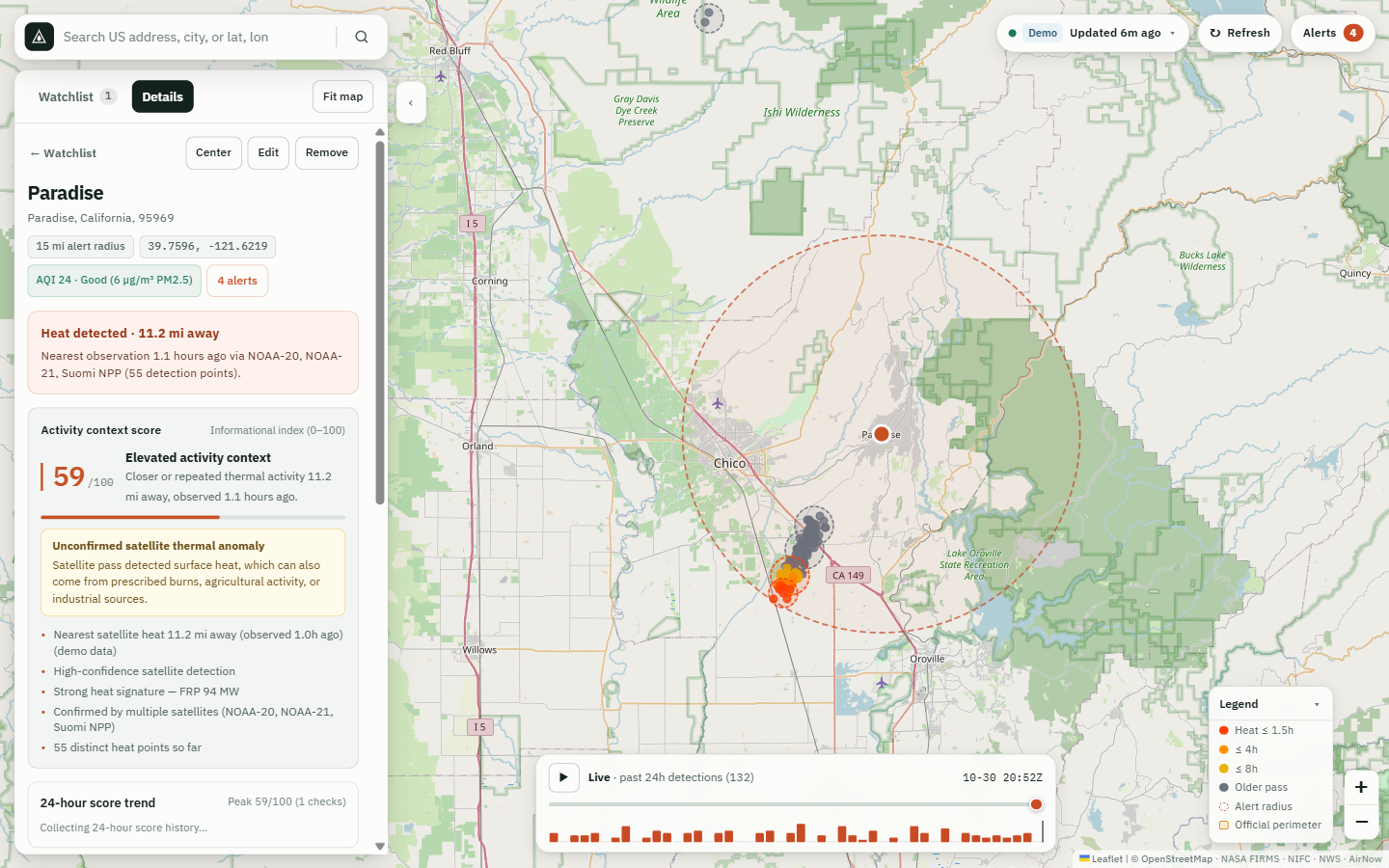
PyroWatch continuously watches places you care about—your home, family addresses, cabins, or campuses—by combining near-real-time satellite heat observations with official incident perimeters, surface weather, and local smoke readings:
- NASA FIRMS VIIRS NRT — polls Suomi NPP, NOAA-20, and NOAA-21 (~375 m thermal anomalies) or runs in zero-key Demo Mode out of the box.
- Spatial-temporal clustering — groups repeated satellite overpasses into distinct heat clusters instead of spamming per pixel.
- NIFC WFIGS enrichment — matches clusters against official US wildfire incidents, acreage, containment %, and active perimeters.
- NWS & EPA AirNow context — pulls National Weather Service gridpoint wind/humidity (downwind alignment) and nearby PM2.5 AQI.
- Explainable 0–100 context score — ranks relevance per
(location, cluster)pair with transparent reasons and explicit limited data flags when feeds are unavailable. - Smart alerts — notifies on
new_groupinside your watch radius,new_satelliteconfirmation, andscore_increase(with cooldown), delivered in-app plus optional Webhook / Slack, SMTP Email, or Windows Desktop Toast.
Important disclaimer: A satellite detection is a thermal anomaly (which can include prescribed burns, agricultural fires, or industrial heat), not a confirmed wildfire. Scores are an informational context index only—never an official warning or evacuation tool. Coverage for NWS, WFIGS, AirNow, and Census geocoding is US-focused (manual
lat, loncoordinates are also supported).
Web Console Highlights
- Map-First Workspace — full-viewport Leaflet map with a collapsible left search/watchlist panel on desktop and a top search bar + 3-stop non-modal bottom sheet (
peek/half/full) on mobile so the map stays interactive at all times. - Search-to-Preview & Explicit Watchlist — US address typeahead (OpenStreetMap Nominatim + US Census Geocoder fallback), direct
lat, lonentry, or opt-in Use my current location (with clear fallback if permission is denied). Selecting a search result pans the map to a preview pin before you explicitly save it. - Location Details & Scoring — selecting a watched location pans the map and opens its 0–100 activity context score, plain-language contributing factors, inside- vs. outside-radius cluster breakdown, AQI chip, and 24-hour score sparkline.
- Compact Map Overlays & Alerts Drawer — floating pills for feed freshness, manual refresh, collapsible map legend, interactive 24-hour detection replay scrubber + histogram, and an on-map alerts panel.
Configuration
All settings are read from .env in the project root (or environment variables). See .env.example for full documentation.
| Variable | Default | Description |
|---|---|---|
FIRMS_MAP_KEY | (empty) | Free key from NASA FIRMS; empty uses demo data when DEMO_MODE=auto |
AIRNOW_API_KEY | (empty) | Free key from EPA AirNow; optional |
DEMO_MODE | auto | auto (demo when no FIRMS key), force (always demo), or off |
FIRMS_FEEDS | VIIRS_SNPP_NRT,VIIRS_NOAA20_NRT,VIIRS_NOAA21_NRT | Comma-separated VIIRS NRT feeds |
FIRMS_DAY_RANGE | 2 | Lookback window (1–5 days) |
POLL_INTERVAL_MINUTES | 10 | Background polling interval (minimum 2) |
DB_PATH | data/pyrowatch.db | SQLite database path (WAL mode) |
HOST / PORT | 127.0.0.1 / 8000 | HTTP server bind address and port |
Outbound Notifications (Optional)
| Channel | Configuration | Notes |
|---|---|---|
| Webhook / Slack | ALERT_WEBHOOK_URL=https://... | POSTs JSON alert batches; set ALERT_WEBHOOK_FORMAT=slack for Slack Block Kit |
| Email (SMTP) | SMTP_HOST=... + ALERT_EMAIL_TO=a@x.com | Supports STARTTLS (SMTP_Port=587, SMTP_TLS=true) or SSL (SMTP_SSL=true, port 465) |
| Windows Toast | ALERT_DESKTOP=true | Enabled by default on Windows (false on macOS/Linux); sends one native WinRT toast per cycle |
Tune alert sensitivity with ALERT_SCORE_DELTA (default 15) and ALERT_SCORE_COOLDOWN_MIN (default 240).
Deployment note: PyroWatch is designed as a single-user local/self-hosted app bound to
127.0.0.1with no built-in user authentication. Do not expose it directly to the public internet without placing it behind an authenticated reverse proxy or tunnel.
JSON API
| Method | Endpoint | Purpose |
|---|---|---|
GET | /api/health (/health) | Liveness probe |
GET | /api/meta | Active configuration, delivery channels, and feed freshness |
GET | /api/dashboard | Full UI payload (locations, clusters, detections, perimeters, alerts) |
GET | /api/geocode/suggest?q=... | US address & coordinate autocomplete suggestions |
GET | /api/locations | List watched locations |
POST | /api/locations | Add a watched location (name, address or lat/lon, radius_miles) |
POST | /api/locations/{id} | Update a watched location |
DELETE | /api/locations/{id} | Delete a watched location and its history |
GET | /api/history/{id} | 24-hour score & distance series for one location |
GET | /api/alerts?limit=100 | Recent alerts |
POST | /api/refresh | Trigger an immediate pipeline cycle |
Development & Tests
pip install -r requirements.txt -r requirements-dev.txt ruff
python -m ruff check .
python -m pytest tests -q
The test suite runs 100% offline using isolated temporary SQLite databases and stubbed upstream responses.
License
Released under the MIT License.