Astro
An answer engine that can actually use your browser — no key to paste
AI: local or publik API
Where Astro’s AI runs, and what it costs
Prices are for one typical use: one request of about 1,500 words sent and 375 words back. A higher quality score is better.
On your computer
- Price
- Free per use. Your computer does the work.
- Runs with
- Ollama, LM Studio
- Memory
- Llama 3.1 8B is a 4.9 GB download at 4-bit. gpt-oss 20B runs on systems with as little as 16GB memory. Faster with Apple silicon or a graphics card.
- Quality
- Llama 3.1 8B: 7
publik API
- Price
- $0.0100 per use, $10.00 per 1,000 usespublik-balanced, the default level
- Quality
- MiMo-V2.6-Pro: 46
- Setup
- Built in. No key to paste; linking your publik account gives $0.05 of free use, once.
Your own key
- Price
- $0.0013 per use, $1.31 per 1,000 usesMiMo-V2.6-Pro at OpenRouter’s list price, before its fee for buying usage
- Quality
- MiMo-V2.6-Pro: 46
- Setup
- Open a provider account, add a card, paste the key into Astro.
Quality and price, side by side
| Model | Quality | Per 1,000 uses |
|---|---|---|
| On your computer (Ollama, 4-bit download size) | ||
| Granite 4.2 3B2.2 GB | 9 | $0 |
| Phi-4 Mini2.5 GB | 6 | $0 |
| Llama 3.1 8B4.9 GB | 7 | $0 |
| gpt-oss 20B14 GB | 9 | $0 |
| Gemma 4 31B20 GB | 19* | $0 |
| Qwen3.5 35B-A3B24 GB | 19* | $0 |
| publik API | ||
| publik-fastGLM-5.3 Flash | 42 | $1.00 |
| publik-balancedMiMo-V2.6-Pro · Astro | 46 | $10.00 |
| publik-smartGPT-6 Sol | 48 | $18.00 |
Quality: Artificial Analysis Intelligence Index v4.3.2, read 2026-09-22 (publik API models 2026-09-25); * = estimated by Artificial Analysis. Sizes: the Ollama library, read 2026-09-22.
What you pay for
- On your computer: nothing per use. You pay in disk space, memory and electricity, at lower quality.
- publik API: publik’s published price for each use, in dollars, from your publik balance. It is above the model’s cost; the difference runs publik and pays the app’s builder.
- Your own key: the provider’s price, billed to an account you keep with the provider.
How to install Astro
Every step written out. No terminal experience needed. Pick your setup.
README
Open in GitHub
Astro
An answer engine that can actually use your browser
Perplexity-style search, deep research and multi-model comparison — on top of a browser its agent can genuinely drive. Bring your own key, or reuse a subscription you already pay for. Search costs nothing and never leaves your machine.
What it is
Two open-source projects, joined at the seam where each is weakest.
Simplicity is a very good answer engine with no browser under it. BrowserOS is a real browser whose agent can drive pages, but it had no retrieval at all — its agent had to open Google and scrape the results page like a person.
Astro puts Simplicity's UI and search pipeline on top of BrowserOS's browser automation. You get an answer engine with citations and an agent that can open tabs, click, read and fill forms — in the same window.
| Search | Free and private. A local SearXNG is provisioned on first use — no Docker, no account, no search API key |
| Deep Research | Plans queries, searches in parallel, reads the best sources in full, refines, and cites |
| Model Council | Several models answer from one shared retrieval; a chair compares them and surfaces the disagreements |
| Browser use | 16 CDP tools — tabs, navigation, clicking, reading, forms, screenshots |
| Your models | Claude Code, Codex and Copilot subscriptions; any API key; or fully local via Ollama / LM Studio |
Scraped page content is fenced as untrusted data before it reaches a model, so a web page cannot issue instructions to your agent.
What is not built
Stated plainly, because the navigation shows more than the code does:
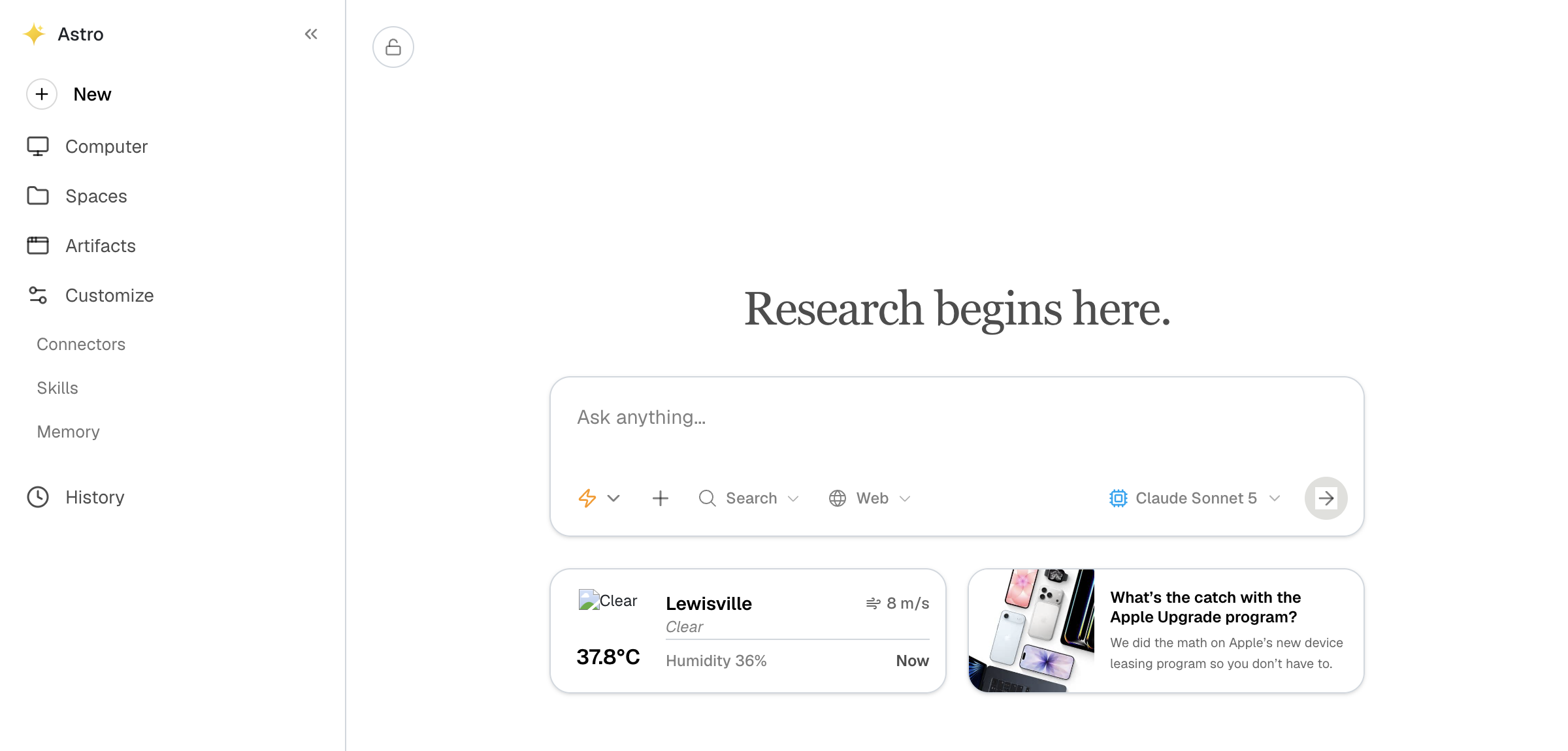
- Computer — Comet's version runs tasks in a cloud sandbox and keeps working
with the laptop closed. Not built. The pieces that exist are
deep_research,model_counciland the browser tools, all synchronous and local. - Spaces, Artifacts, Skills, Memory — navigation entries only.
- File generation (.pptx / .xlsx) — absent here and in both upstreams.
Licences
Astro is AGPL-3.0, inherited from BrowserOS, which is based on Chromium and uses patches from ungoogled-chromium.
The vendored Simplicity/Vane code is MIT, © ItzCrazyKns.
ATTRIBUTION.md
carries the notice, maps every ported file to its source, and documents where
this fork deliberately diverges from both.